

India could reduce its annual crude oil and battery import expenditure by up to $125 billion by 2050 by accelerating electric vehicle (EV) adoption across road transport, according to a working paper by the International Council on Clean Transportation (ICCT).
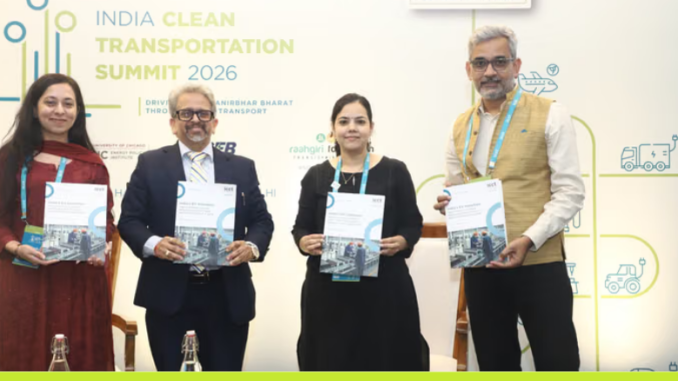
The study, released at the India Clean Transportation Summit 2026, highlights the economic benefits of shifting rapidly from petrol and diesel vehicles to electric mobility.
Faster EV Adoption Could Deliver $94 Billion in Savings
According to the study, $94 billion of the potential annual savings could come from EV adoption alone, even if India continues importing all battery cells.
The remaining $31 billion would depend on achieving greater self-sufficiency through domestic battery cell manufacturing.
The findings underline that avoiding crude oil imports could generate significantly greater savings than the cost of importing battery cells.
Oil Prices Make Electrification Even More Valuable
The study estimates that the gap between slow and fast EV adoption pathways could reach:
- $104 billion in annual import costs under the baseline oil price scenario.
- $166 billion under a high crude oil price scenario.
- Up to 82% reduction in road transport import expenditure with rapid EV adoption and domestic battery production.
ICCT India Managing Director Amit Bhatt said faster electrification would reduce India’s exposure to global crude oil price volatility while strengthening its push for Aatmanirbhar Bharat.
Battery Demand Set to Surge After 2030
The research models battery requirements across two-wheelers, three-wheelers, passenger cars, LCVs, buses and heavy trucks.
India’s annual battery demand could reach:
- 340 GWh by 2050 under baseline projections.
- 573 GWh by 2050 under aggressive EV adoption.
Almost all battery cells are expected to be imported through 2030 as domestic manufacturing capacity scales up.
Localization Could Strengthen India’s EV Economy
The study concludes that rapid EV adoption itself could cut India’s road transport import bill by 61% by 2050, while combining electrification with domestic battery manufacturing could increase savings to 82%, equivalent to around $125 billion annually.