
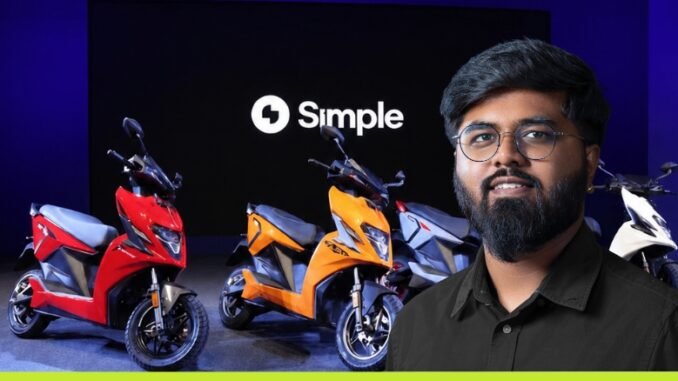
Bengaluru-based EV manufacturer Simple Energy has secured ₹250 crore in a Series B funding round as the company looks to scale manufacturing, expand retail presence, and strengthen its vertically integrated EV technology ecosystem.
The funding round was completed through a mix of debt and equity and saw participation from the family office of Dr. Arokiaswamy Velumani along with the company’s founders. Debt financing was supported by HDFC Bank, Capital Ventures, and other NBFC partners.
The investment comes at a critical time for India’s electric two-wheeler industry, where manufacturers are increasingly being evaluated on scalability, operational execution, and long-term financial sustainability rather than just product launches.
Strong Revenue Growth Signals Market Traction
Simple Energy reported revenue growth from ₹40 crore in FY25 to ₹170 crore in FY26, reflecting rising consumer traction in India’s competitive EV two-wheeler market.
The company currently sells around 1,500 scooters per month and operates through more than 71 outlets across 38 cities including Bengaluru, Delhi, Chennai, and Patna.
Key Highlights Of The Expansion Plan
- ₹250 crore raised through debt and equity
- Production capacity expansion underway
- Battery manufacturing investments planned
- Target of 10,000 monthly sales by March 2027
- Expansion into additional Tier-2 and Tier-3 markets
Vertical Integration Becoming A Competitive Advantage
Simple Energy has positioned itself as a vertically integrated EV manufacturer with in-house development across chassis, battery, motor, and software systems.
The company also claims advancements in heavy rare-earth-free motor technology and lifetime warranty offerings for key EV components, signalling growing focus on localisation and technology control.
HEV’s Take
India’s EV market is rapidly entering an execution-driven phase where manufacturing depth, supply chain control, and capital efficiency may become bigger differentiators than brand visibility alone. Companies capable of scaling sustainably while maintaining technology ownership could emerge as long-term market leaders.