
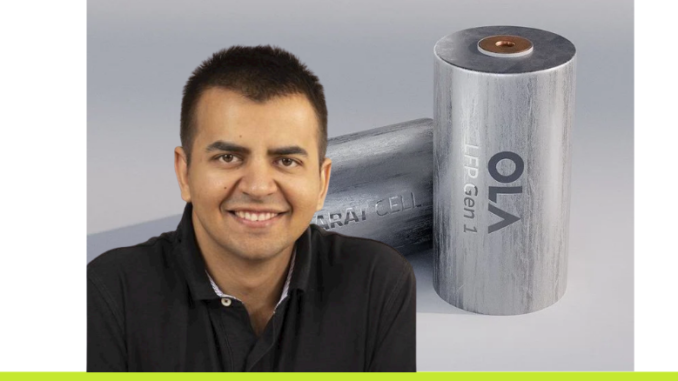
India’s efforts to localise battery manufacturing have received a significant boost with Ola Electric’s latest achievement in cell technology. Ola Electric’s wholly owned subsidiary, Ola Cell Technologies (OCT), has become the first Indian company to secure Bureau of Indian Standards (BIS) certification for an indigenously developed 46100 LFP cylindrical battery cell.
The development marks an important milestone for India’s EV supply chain as the country seeks to reduce dependence on imported battery technologies and build domestic manufacturing capabilities.
First Indian Company To Achieve BIS Certification
The 46100 LFP cylindrical cell has received certification under IS 16046 (Part 2):2018 / IEC 62133-2:2017 standards.
The battery cell also complies with:
• IS 16893 Part 2 standards
• IS 16893 Part 3 standards
• UN 38.3 safety standards
The certification validates the safety, reliability, and performance of the indigenously developed battery cell while bringing India closer to building a self-reliant battery ecosystem.
Expanding Ola’s Battery Portfolio
The newly certified cell expands Ola’s growing portfolio of in-house battery technologies.
Key highlights include:
• Indigenous 46100 LFP cylindrical cell
• 4680 Bharat Cell programme
• Energy density exceeding 170 Wh/kg
• Applications in electric vehicles and energy storage systems
• Development of both LFP and NMC battery chemistries
According to the company, both battery technologies are being developed on a common 46-series architecture at its Gigafactory.
Why The Milestone Matters
Battery cells remain one of the most critical and value-intensive components in the EV ecosystem. While India has made significant progress in vehicle manufacturing, cell production has largely remained dependent on imports.
Ola’s BIS certification highlights the growing capability of Indian companies to develop advanced battery technologies locally. As domestic cell manufacturing scales up, it could strengthen supply chain resilience, support energy storage deployment, reduce import dependence, and accelerate India’s transition towards electric mobility.