

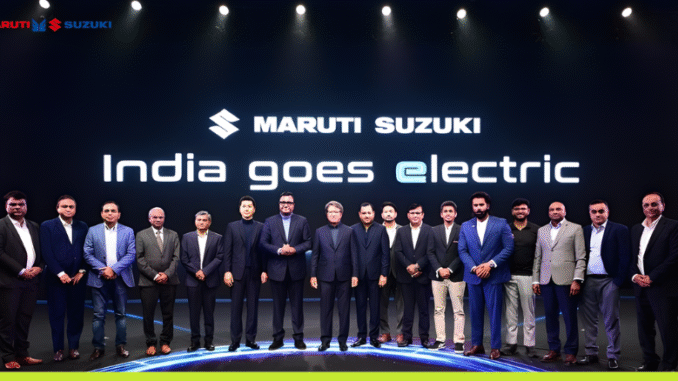

“One India, One EV Charging” Consolidated Access to Chargers Nationwide
Maruti Suzuki has launched a unified EV charging platform aimed at simplifying access to charging infrastructure across India. The initiative combines the automaker’s own network over 2,000 exclusive charging points spread across more than 1,100 cities with those of 13 Charge-Point Operators (CPOs) and aggregators.Through this integrated ecosystem, users can locate nearby chargers, pay digitally, and access both home and public charging with ease.
Single App for Discovery, Booking, and Payment
The platform is implemented through the “e for me” EV charging app, which provides a unified user experience. EV owners can discover charging stations, check real-time availability, book slots, and complete payments through UPI or Maruti-backed payments using Maruti Suzuki Money.This removes the need for multiple apps and memberships, streamlining the charging journey for users.
Preparing for e-Vitara Launch and Long-Term Charging Goals
Maruti’s unified charging push comes parallel with the upcoming launch of its first electric vehicle, the e-Vitara, expected in early 2026. The company aims to scale its public charging network substantially, targeting 100,000 public chargers by 2030 a massive expansion to support India’s growing EV adoption.
In addition, Maruti is preparing a nationwide EV-support infrastructure with a trained EV-ready workforce, and plans for smart home charger installation for buyers to ensure a smooth ownership experience.
Implications for India’s EV Ecosystem
By consolidating multiple charging networks into one unified platform, Maruti Suzuki is solving a key barrier charging fragmentation that has often discouraged EV adoption in India. This approach can boost charger utilisation, reduce range anxiety, and create a more predictable charging ecosystem for prospective EV buyers. For other OEMs and CPOs, Maruti’s model sets a benchmark for collaborative, customer-centric charging infrastructure development.