

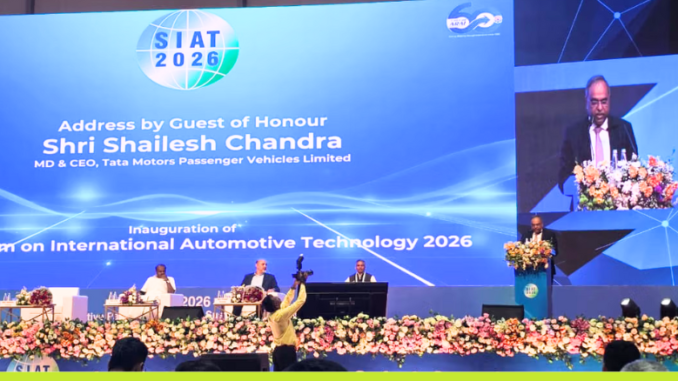
India’s EV opportunity beyond domestic markets
At SIAT 2026 organised by the Automotive Research Association of India (ARAI), Shailesh Chandra, Managing Director of Tata Motors Passenger Vehicles, articulated a bold vision for India’s role in electric mobility. Chandra said India has a “unique opportunity” to position itself as a global centre for electric and sustainable mobility, supported by strong manufacturing capabilities, evolving technology adoption, and collaborative innovation across industry and academia. India’s mobility transformation driven by electrification, emission reduction and changing consumer expectations could serve as a catalyst for long-term industrial leadership and export competitiveness.
Rather than viewing the shift to electrification solely as a regulatory challenge, Chandra emphasised that it should be embraced as a strategic opportunity for India to attract global value chains, scale production and develop advanced technology. This perspective aligns with broader industry narratives that frame electrification as a competitive advantage and a means to integrate India more deeply into global automotive ecosystems.
Sustainability, safety, and technology convergence
Chandra highlighted that India’s automotive sector is navigating a convergence of sustainability, safety and rapid technological change. He said that as India’s economy grows and mobility aspirations expand, aligning these forces with cleaner technologies will be essential. Stronger safety practices, active safety systems and credible testing infrastructure are now becoming priorities rather than afterthoughts. Chandra also noted that Indian customers are increasingly informed and expect advanced connectivity, digital experiences, and ongoing software-driven improvements in vehicles a shift from traditional mechanical product expectations to software-defined vehicles.
Looking ahead, Chandra stressed the importance of deeper collaboration across the automotive value chain including manufacturers, suppliers, policymakers and educational institutions to industrialise new technologies at scale. He said that harnessing India’s engineering talent, manufacturing base and digital adoption will be crucial to transforming the country’s mobility ecosystem from a primarily domestic focus to a globally competitive platform for innovation and production.

