
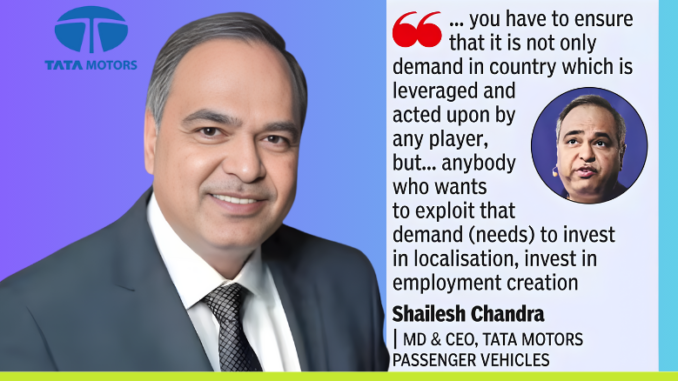
Tata Motors has said that foreign electric vehicle manufacturers eyeing India’s rapidly expanding EV market must ensure strong commitments to localisation, capability building and job creation. The country’s largest EV carmaker stressed that global players should not merely leverage India’s demand but also contribute meaningfully to the domestic ecosystem.
Responding to questions on whether the Indian automotive industry is prepared to compete with Chinese EV manufacturers, Tata Motors Passenger Vehicles MD & CEO Shailesh Chandra said government decisions will be guided by what is best for the country. He added that policymakers will evaluate multiple factors before allowing new players and technologies into the market.
Local value addition key to foreign EV entry
According to Chandra, while India remains open to inviting new technologies and companies, such participation must come with full commitment to local investments. These include building manufacturing capabilities, investing in local value addition and creating employment opportunities.
He stated that companies should not simply exploit domestic demand to boost volumes, but instead reinvest in India’s EV ecosystem. The government, he said, evaluates these aspects holistically before taking a call on allowing new entrants.
Tata Motors’ EV expansion plans
Chandra also outlined Tata Motors’ future EV roadmap, revealing plans to roll out five new electric vehicle models, including offerings under the premium Avinya brand. The company plans to invest up to ₹18,000 crore by 2029 – 30 as it aims to retain a dominant 45-50% market share in India’s growing electric passenger vehicle segment.
He added that Tata Motors’ long-term focus is on mainstreaming electric mobility by making EVs accessible across segments, strengthening the supporting ecosystem and investing in India-first technology and localisation. These initiatives, he said, will help the company continue leading India’s EV transition.